

Taking your pet from Australia to Europe might feel daunting, but it’s absolutely achievable with the right preparation. Thousands of pets travel each year, and there’s a clear process to follow.
It’s normal to worry about paperwork and entry requirements. The rules are complex, but with help and the proper preparation, the journey can be as stress-free as possible.
When each requirement is met in the right order, problems are far less likely.
In this article, we’ll explain the key EU entry rules your pet must meet. We’ll also walk through the Australian export process, so you know what to do before departure.
Travelling with Pets to the EU from Australia
Requirements apply to dogs and cats entering the EU and are designed to protect animal and public health. When these conditions are met, travel is usually straightforward.
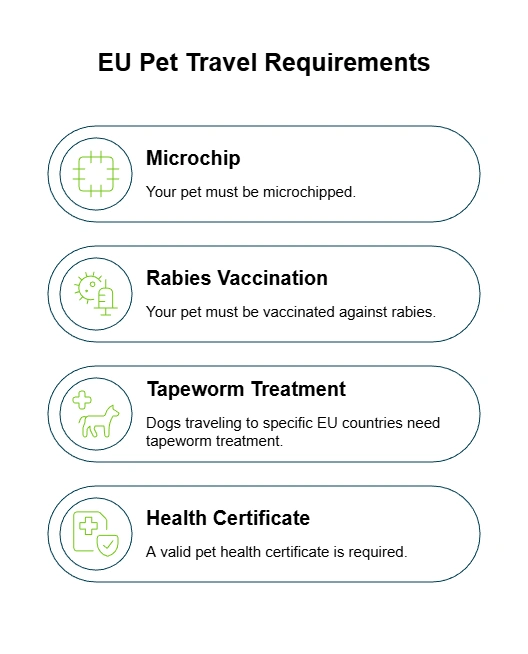
Your pet can travel to the EU from Australia if it has:
- Been microchipped
- Been vaccinated against rabies
- Had treatment against the tapeworm Echinococcus multilocularis (dogs only), if your destination is Finland, Ireland, Malta, Norway or Northern Ireland
- A valid pet health certificate
Microchipping for Pets Travelling to the EU
Microchipping your pet is an essential first step. Correct identification is vital, because every document, vaccination and border check links back to how your pet is identified. If there’s a mismatch at any stage, it can delay travel or prevent entry.
Microchip Requirements
Your pet must be fitted with an ISO-compliant microchip that meets EU standards. These chips use a 15-digit number that can be read by scanners across Europe. If your pet already has a microchip, confirm it meets these standards.
The microchip must be implanted before any rabies vaccination is given. This order matters. If the vaccination was administered first, it may not be recognised as valid for EU travel.
Rabies Vaccination Requirements for Pet Travel to the EU
Rabies vaccination is one of the most important steps when travelling with your pet from Australia to Europe. Although Australia is a rabies-free country, the EU applies strict rules to prevent the disease from spreading. Getting the timing right is essential.
Primary Rabies Vaccination Rules
Your pet must be at least 12 weeks old before getting their first rabies vaccination. The vaccine must be given after your pet has been microchipped; otherwise, it won’t be considered valid for international pet travel.
Once the primary rabies vaccination is administered, you must wait at least 21 days before your pet can enter the EU. This waiting period allows your pet to develop sufficient immunity and cannot be shortened.
Booster Rabies Vaccinations
If your pet has been vaccinated against rabies before, we can advise whether it needs a booster vaccination before travelling. Booster vaccinations must be given before the previous vaccination expires.
If a booster is missed or administered late, the next vaccination is considered a primary vaccination. This resets the 21-day waiting period before travel, which can delay departure.
Rabies Vaccination Exceptions (Young Dogs and Cats)
You can travel with your young pet dog or cat to Czechia and Switzerland if:
- It’s less than 12 weeks old and has not been vaccinated against rabies
- It’s between 12 and 16 weeks old and has been vaccinated, but is not yet immune to rabies
To be allowed to travel in these cases:
- You must either have a declaration attached to your pet health certificate stating that it has had no contact from birth up until the time of travel with any wild animal species prone to rabies
or
- Your pet must be accompanied by its mother, whose pet health certificate clearly shows that she has had an anti-rabies vaccination before giving birth
Tapeworm Treatment Rules (Dogs Only)
Some EU destinations have extra health safeguards in place for dogs. One of these is mandatory treatment for the tapeworm Echinococcus multilocularis.
Echinococcus multilocularis Treatment Requirements
Dogs travelling to Finland, Ireland, Malta, Norway and Northern Ireland must receive treatment for Echinococcus multilocularis before entry.
- The treatment must be administered between 24 and 120 hours (one to five days) before travel.
- All details of the treatment must be entered in your pet’s health certificate.
Timing is strict. If the treatment falls outside this window, your dog may be refused entry or placed into quarantine.
Required Travel Documents for Entering the EU
Having the correct travel documents is essential when entering the EU with your pet. Border authorities will check these documents, and missing or incorrect paperwork can result in delays, quarantine or entry refusal.
Health Certificate
If you’re travelling from Australia to the EU, your pet will need a valid health certificate. This certificate confirms your pet meets all EU entry requirements.
The certificate must be issued by an official state veterinarian here in Australia. It must be completed no more than 10 days before arrival in the EU.
Once issued, the certificate is valid for:
- Travel within the EU for up to four months, or
- Until the rabies vaccination expires, whichever comes first
All details must match your pet’s identification and vaccination records exactly.
Entering the EU with Your Pet
The final stage of your pet’s journey is entering the EU. This is where all preparation comes together, and border checks confirm your pet meets the required health and identification standards.
Designated Travellers’ Points of Entry
You must enter the EU with your pet through a designated traveller’s point of entry in your destination country. These entry points are approved to handle pet inspections and document checks.
For instance, here are the designated entry points for Ireland:
- Cork Airport
- Dublin Airport
- Dublin Port
- Port of Cork – Ringaskiddy
- Rosslare Port
- Shannon Airport
So, if you’re travelling to Ireland with your pet, you must arrive at one of these entry points.
Border Checks and Compliance
On arrival, authorities will make several checks. These include:
- Document verification, ensuring health certificates and paperwork are correct
- Identity checks, where your pet’s microchip is scanned and matched to the paperwork
If everything is in order, your pet can continue their journey with you.
If requirements aren’t met, authorities may take further action. This can include returning your pet to the country of departure or placing them in quarantine until they comply with EU rules. Careful preparation greatly reduces the risk of these outcomes.
Exporting Your Pet from Australia
Meeting EU entry rules is only part of the process. You must also follow the process for Australian pet exports before your pet can travel internationally.
These rules ensure pets are healthy, properly prepared and travelling in line with Australian law.
Here’s what’s involved in getting a pet export permit from Australia.
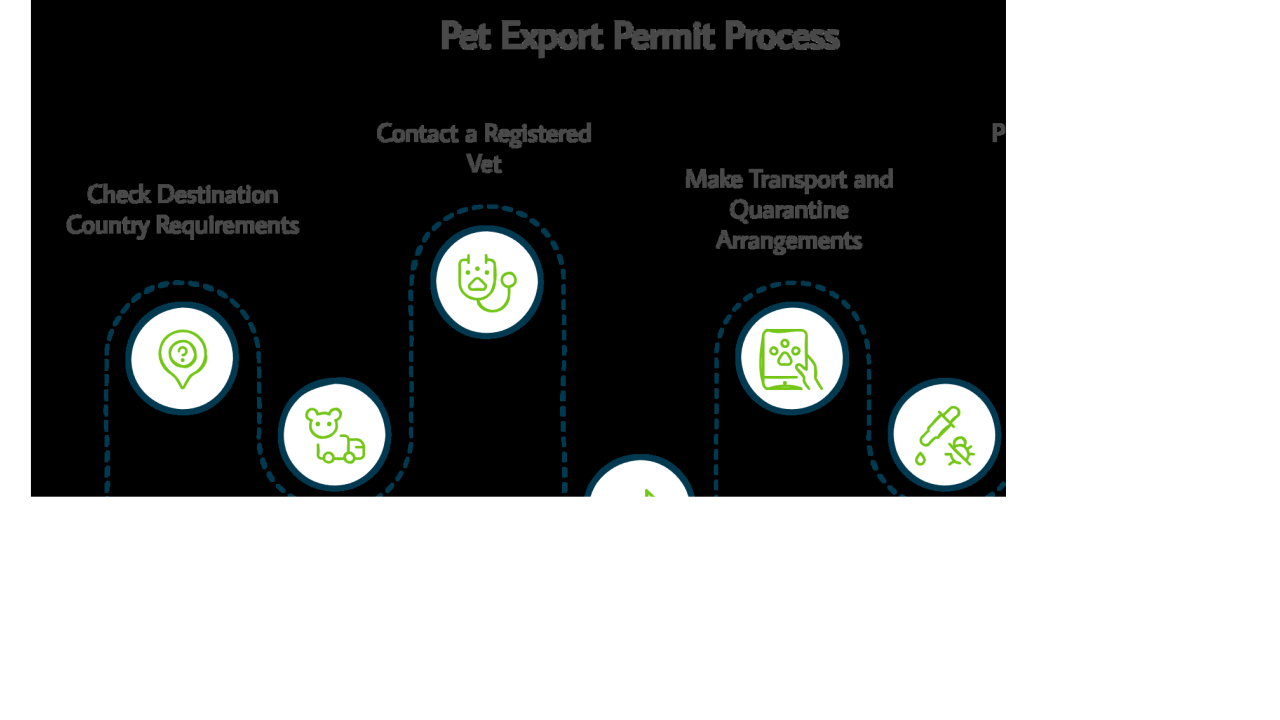
Step 1: Check Destination Requirements
Now, you already know the requirements for taking your pet from Australia to Europe. If you’re unsure about anything, you can also contact a pet transport company such as Dogtainers for further advice.
Step 2: Book a Pet Transport Company
Working with a professional pet transport company is essential for exporting pets from Australia. We also make the process as stress-free as possible.
Our experts understand the rules, paperwork and logistics involved inside and out. We take a lot of the stress off your plate and ensure the process goes smoothly.
The best pet transport provider will help with flights, crate sizing, documentation, timing and more.
Step 3: Contact a Registered Vet
You must work with an approved veterinarian in Australia, preferably one who’s experienced with international pet transport. If you use our services, we provide registered vets who know exactly how the pet travel process works.
They’ll help you with:
- Microchipping
- Health checks
- Vaccinations
- Parasite treatments
Booking these appointments well in advance is vital. But don’t worry, Dogtainers helps you every step of the way.
Step 4: Submit a Notice of Intention to Export
Once your timeline and travel details are confirmed, you (or your pet transport provider) will need to submit a Notice of Intention to Export to the Department of Agriculture, Fisheries and Forestry (DAFF).
This form gives the department details about:
- Your pet (species, breed, age, microchip number)
- Your export plans (dates, flight info)
- The destination country’s requirements
Step 5: Make Transport and Quarantine Arrangements
Depending on your destination within Europe, your pet may need to:
- Fly on a specific airline or route
- Be housed at an approved facility before or after travel
- Complete quarantine at the destination country
Now’s the time to book flights, confirm crate details, and make any required quarantine bookings. Dogtainers can guide you through this process to make sure all boxes are ticked.
Step 6: Prepare Your Pet for Export (Treatments, Vaccinations, etc.)
Based on the import conditions for the EU, your pet needs:
- Microchipping
- Rabies vaccination or booster
- Tapeworm treatment (for certain countries)
These treatments must be done within a specific time frame before travel, so follow the schedule carefully. Keep records of everything, as you’ll need to show them at your final appointments.
Step 7: Arrange a Final Vet Examination
Before your pet can fly, they must pass a final health check to confirm they’re fit for travel and meet the destination country’s requirements.
This check is done by your registered vet and includes a final review of all treatments and paperwork. If everything is in order, the vet will issue a Veterinary Health Certificate, which is essential for your permit application.
Step 8: Arrange a Pre-Export Appointment with DAFF
Booking a pre-export inspection with the DAFF is the last step. You must have all documentation completed to demonstrate your pet meets the destination country requirements. You can provide everything by email before your inspection appointment or present it during the appointment.
Note: Dogtainers can attend this appointment on your behalf.
At this appointment, the certifying government vet will:
- Check your pet’s microchip
- Review all health documents
- Confirm your pet is fit and safe to fly
The certifying vet determines if your pet is eligible for export.
Some countries need DAFF officers to verify an animal’s identity. In this case, your pet must attend the appointment with you. Otherwise, your pet doesn’t need to be there, as the DAFF vet just needs to verify all documentation.
Authorities issue your export permit and health certificate when your:
- Pet has been prepared in line with the importing country’s requirements
- Consignment complies with Australian export legislation
Taking Your Pet from Australia to Europe with Dogtainers
Although taking your pet from Australia to Europe takes attention and preparation, it doesn’t have to be stressful. With Dogtainers, our experts help you every step of the way to ensure every stage of the process is completed correctly.
We guide you through everything, from advising you on pet eligibility to arranging vet inspections. You don’t have to go through the process alone.

Our experts have been helping pet owners like you with international pet transport for over 50 years. We’re Australia’s oldest and most reliable pet transport company with:
- Vast experience
- Industry credentials
- Tailored services
- Reliable global networks
- Strong airline partnerships
- Deep regulatory knowledge
Conclusion
Bringing your pet to the EU takes planning, organisation and attention to detail. Each step builds on the last, so starting early makes a real difference. When timelines are followed and documents are accurate, problems are far less likely.
Although the process is complex, it’s manageable with guidance from a pet transport company like Dogtainers. Professional support helps remove uncertainty and reduce stress along the way.
Dogtainers has supported families, travellers, and their pets for more than 50 years. Our team understands the process in detail, and we’re here to guide you through it with care and clarity for a stress-free journey.
Get your quote today for relocating your pet from Australia to Europe.
Pet Travel to Europe from Australia FAQ
How long does it take to prepare a pet for travel from Australia to the EU?
For travel from Australia to the EU, we recommend preparing at least 6 months in advance. Starting early allows time for microchipping, rabies vaccination, paperwork, and export approvals.
Does my pet need a rabies antibody test to travel to Europe from Australia?
No, pets travelling from Australia to the EU don’t need a rabies antibody test. However, they do need proof of the rabies vaccination.
What happens if my pet’s microchip or paperwork doesn’t match at the EU border?
If details don’t match, your pet may be refused entry, returned to Australia, or placed into quarantine until the issue is resolved.
Which EU countries require tapeworm treatment for dogs before entry?
Dogs must receive tapeworm treatment before arriving in Finland, Ireland, Malta, Norway and Northern Ireland if you’re travelling from Australia. Treatment must be given against the tapeworm Echinococcus multilocularis between 24 and 120 hours (1-5 days) before travel.
Do I need to complete both EU entry requirements and Australian export steps?
Yes, you must meet the EU entry requirements to get an Australian export permit. If your pet only meets some of the EU requirements, DAFF won’t issue an export permit. Then, your pet won’t be able to leave Australia.



Share this article